Why a Route Can Change the Feel of a Journey
See how route sequence changes the feel of a journey, then shape the links between stops to make each arrival clearer and leave room for discovery.
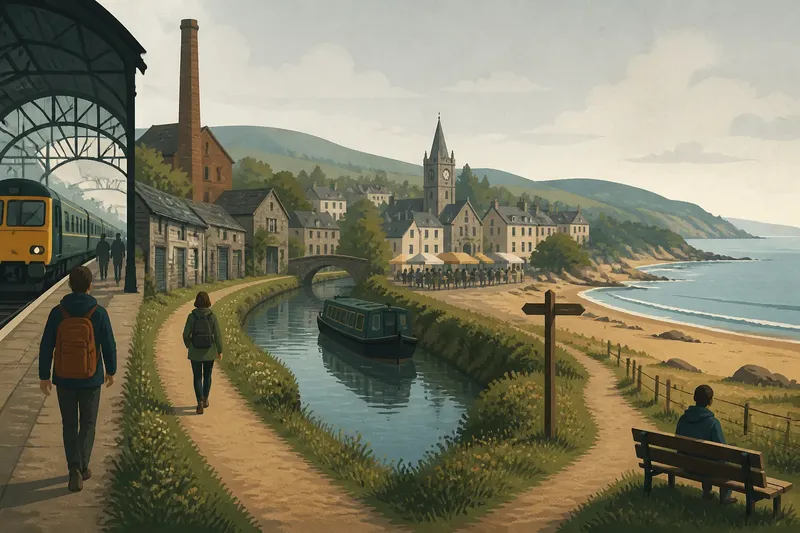
You step off a train beneath a grey sky, follow a canal path past shuttered workshops, then reach a village as its bakery opens. The route sequence changes the feel of the journey: the same places in a different order would give each arrival a different approach.
Start by deciding what sort of journey you want, then arrange its broad movements and look closely at the connections between them. The aim is not to choreograph every moment. It is to make the route support the experience you have in mind while leaving space for what catches your attention.
Choose the journey’s character before its destinations
Write down a few words for the quality you hope the journey will have: spacious, varied, sociable, contemplative or full of contrast. They are not promises about how you will feel. They are editing criteria for choosing between routes that both appeal.
Then consider what might help that quality emerge. A spacious journey could include a legible stretch between places with few decisions along the way. A journey built around contrast might move from a busy waterfront to a quiet inland settlement. The question is not simply whether to add stops; it is how each section relates to the next.
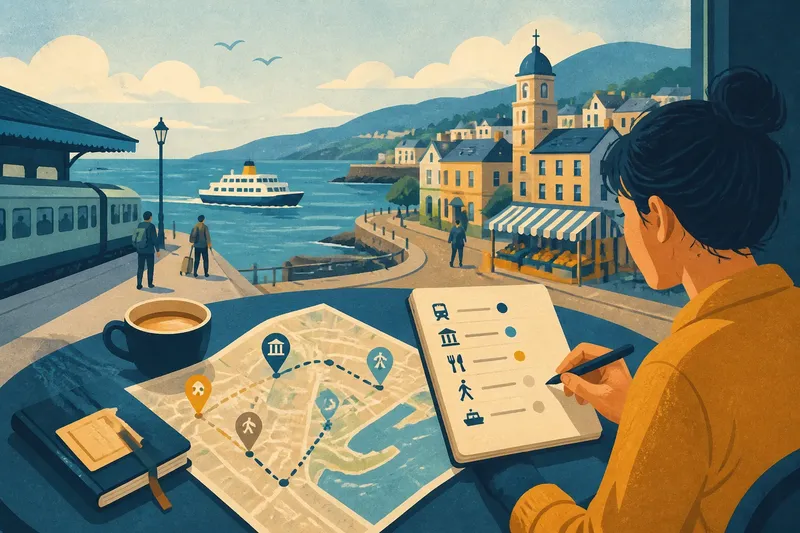
Keep destinations provisional. Mark candidate places and connections on a paper map, a rail map or OpenStreetMap. Notice which links feel like continuations and which create a sharp shift in setting or pace. A neat line on a screen does not necessarily make a meaningful sequence.
Arrange stops as a sequence, not a collection
Give each stop a role. One might be a threshold where the surroundings begin to change; another could be a pause that lets a landscape settle in your mind. A later stop might offer a clear contrast. A place need not be famous to make the sequence work.
Try describing the route as a chain: “leave the dense centre, follow the river, arrive at the edge of the hills”. That sentence includes a transition as well as a destination. If your description is only a list of place names, ask whether the order hides a connection you care about—or whether an intentional jump is the point.
Imagine you are planning a journey from a crowded rail hub to a small coastal town, with a riverside market town between them. If you want the coast to feel like a release, place the market town first. The observable result in the plan is a progression from a busy hub through a river setting towards the coast, rather than a return to bustle after reaching it. The arrangement cannot dictate your mood or the weather.
Stops also shape what you carry forward. A quiet walk may make a station concourse feel louder; an absorbing museum visit may leave little appetite for another indoor stop. You cannot schedule those responses, but you can avoid stacking demanding experiences simply because they look close on a map.
Shape the transitions between places
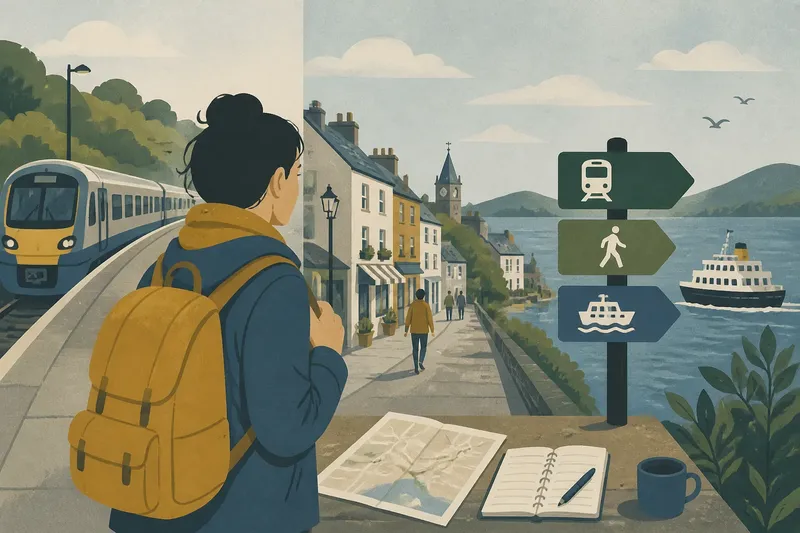
A transition is the lived part between stops: the walk from a platform to an old centre, a ferry crossing, a bus ride through suburbs or the footpath between stations. These links can make a change of place feel gradual, abrupt, tiring or revealing.
Look at each connection from a traveller’s point of view. Where do you leave one setting? What lies between it and the next? Does the landscape, sound or activity change gradually, or does the journey jump from one centre to another? Either can work. The question is whether the connection suits the character you chose.
- Departure point: Check whether the route begins at a station, quay, trail junction or neighbourhood street. If that starting point fits your intended opening, keep it; if it drops you straight into the wrong setting, choose a different approach.
- Middle section: Check the map for canals, open ground, industrial edges, wooded paths or long stretches with little to observe. If the middle builds a transition you want, retain it; if it adds an unhelpful gap, look for another connection.
- Arrival point: Check whether the route enters the next place gradually or ends at its busiest point. If the approach supports the arrival you want, keep it; if not, consider a different station, landing or path into town.
- Change of mode: Check where a rail, walking or water connection requires a transfer. If the change offers a useful pause, retain it; if it interrupts the journey without adding anything you value, compare a more direct link.
- Current access: Check operator notices, station plans and local trail signs for the connections you intend to use. If the route is open and workable, keep it in the plan; if access or service has changed, follow current local guidance and choose an available alternative.
- Purpose of the gap: Check what a long or awkward-looking link contributes. If it builds anticipation or offers a distinct view, keep it; if it contributes nothing to the route’s character, remove it or replace it with a simpler connection.
A map shows the outline, while local transport maps, station plans and trail signs can clarify the details. For current services and access, use the relevant operator information and local notices.
Use contrast and repetition deliberately
Contrast gives a journey shape. Moving from enclosed streets to open water can sharpen the change in setting; taking the reverse route may make a return to narrow lanes feel intimate. Repetition can also create a thread. Several stretches beside water, for instance, may link otherwise different places.
Too much contrast can make a route feel like disconnected scenes, while too much repetition can flatten it. Look for a link between stops, perhaps a river valley, changing building materials or the way settlements gather around transport. The thread need not be a theme you explain at every turn. It can simply help the route feel composed.
There is no single right balance. A sharp break may be exactly what you want, while a steady succession of related landscapes may suit you better. Decide which effect you are after before smoothing away every irregularity on the map.
Check the route’s rhythm without turning it into a timetable
Once the sequence feels coherent, scan for changes in demand. Some sections call for concentration: finding a trail, making a transfer or arriving somewhere unfamiliar. Others leave room to look around. A useful rhythm does not require every stretch to be productive.
Mark connections that depend on a specific service and sections that can remain open. A ferry departure or limited train service may shape where a stop belongs. A flexible walk through the countryside may work better as an unhurried link than as a tightly allotted slot. Check current timetables for actual services, but remember that a workable connection is only part of the experience.
Review the route from both directions, even if you plan to travel one way. Ask what the first stop prepares you to notice, what the middle changes and what the final arrival inherits. If the ending feels like an afterthought, try a different approach; the destination itself may still be right.
What should you ask before settling on a route?
Does the order of stops change the journey?
It can change how places connect, contrast or feel disjointed. Reversing a sequence also changes the approach to each arrival and which part of the landscape stands out first.
Should every transition be scenic?
No. A plain transfer can provide a pause, and a direct connection may suit the journey better than a picturesque detour. Keep a link for the role it serves, not because every stretch must look remarkable on a map.
How can you compare two possible sequences?
Describe each as a short progression, including the connections rather than listing destinations alone. Compare how each version begins, changes and ends, then choose the one that better matches the journey’s intended character.
What if the route feels different once you are travelling?
Let actual conditions reshape the plan. A closed path, missed connection or absorbing stop can alter what makes sense next; keep the broad idea of the journey and adapt the sequence where needed.
Keep one useful thread and leave room for discovery
Before setting off, describe the route in plain language—not as a theme to perform, but as a reminder of why its parts belong together. “Follow the river from the railway town towards the estuary” may be enough. It makes the relationship visible while leaving room for a detour, a closed door or a place that holds your attention.
Route sequence changes the feel of a journey because transitions give places context and edges. Choose the character first, arrange stops into a progression, then keep the connections that make it legible. A final check of current access and service information can help you choose a workable alternative if the route changes, without closing off the discoveries that make the journey your own.